Scripture: “And if I go and prepare a place for you, I will come again, and receive you unto myself; that where I am, there ye may be also.” – John 14:3
Examination of Chapter: In this chapter, Jesus explains to His followers that He will be leaving them soon, but it is because He is preparing a future home for them in which they will be with Him forever. Of course, He is referring to the heavenly home that all believers are promised, but it is a hard time for His disciples in that Jesus is preparing them for a time of separation and hardship as well. He goes on to say that He will send His Spirit to abide with them, providing comfort and support until He and they are reunited.
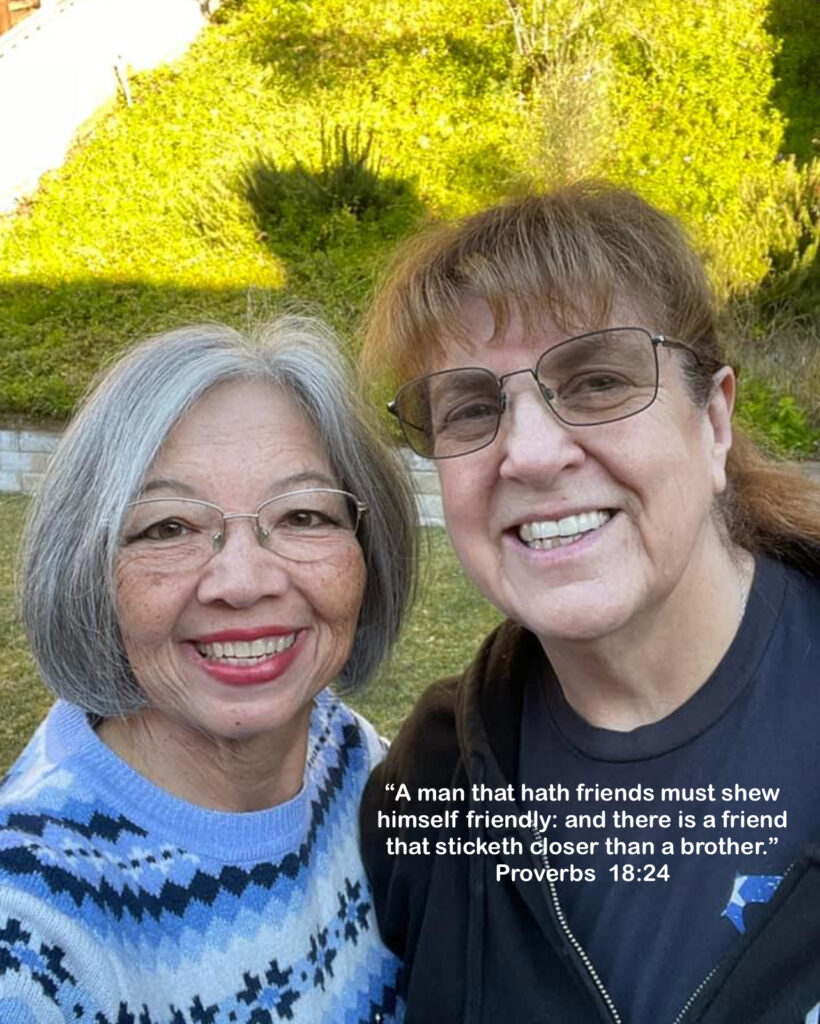
Application: In my first year of junior high school, I met a girl named Lorrie, who quickly became my dearest friend. We laughed together, cried together, helped each other through the tough times of adolescence, and as we grew older, the support and encouragement for one another never wavered. We stood up for each other at our weddings, embraced each other through funerals, and eventually life took us physically apart, but we always kept in touch. Now, nearly 60 years later, we remain as close as we were when we were teens. Today’s technological tools make it easier to stay connected. We still text, facetime, and call one another on a regular basis.
Recently, my friend called and asked if I’d like a visit from her! Would I ever!! Of course, I said yes, and before too long, I was at the airport running toward her! We wrapped our arms around each other in a long overdue hug, and took off as if we’d never been apart!
I have another friend that I met close to the same time as when I met Lorrie. Through the years, we have stayed in touch regularly, and those times have been so precious to me. In fact, I can’t imagine a day without Him. His name is Jesus. He keeps in close contact with me through His Word, and I reach out to Him through my prayers. He has even given me His Spirit to comfort me, guide me, and sometimes correct me when I am heading down a wrong path.
While every day with Jesus is wonderful, I know it will not compare to the day that I see Him in person. Currently, 2 Corinthians 5:7 tells me, “For we walk by faith, not by sight:”, but one day, Jesus tells me in His word that one day I will see Him face to face (Revelation 22:4).
When I saw Lorrie at the airport, the happiness within my heart was overflowing, but I know it will not compare to the joy that will flood my soul when I finally see my Saviour, Jesus, face to face. Until then, I shall continue to keep in touch with Him, looking forward to that incredible moment when I “…shall see him as He is.” (I John 3:2). When I think of Jesus, my soul sings; I cannot imagine my reaction when my faith does become sight, and I am in the presence of the One who loves me with an everlasting love (Jeremiah 31:3). Oh, what a moment!
Meditation:
“Whom having not seen, ye love; in whom, though now ye see him not, yet believing, ye rejoice with joy unspeakable and full of glory:” – 1 Peter 1:8
How long has it been since you’ve connected with Jesus? Why not take a moment to send a short prayer or read a verse or two from the Bible right now!
Scripture: “Beloved, I wish above all things that thou mayest prosper and be in health, even as thy soul prospereth.” – 1 John 3:2
Examination of Chapter: In this book, John is commending the believers for their “faith in action”. Their testimony of faith had been made known to him, and now in this letter, he is writing to tell them that their work for Christ has brought him great joy.
Application: I’ve been to doctors all my life. I don’t suffer from “white coat” syndrome, and the visits are usually without any major revelations to my health. However, in this new age of technology, I often get my lab results prior to my scheduled visit. I have the time to look them over, so there are no surprises when I see my physician.
This time I saw that several numbers were labeled as “abnormal”. While the numbers were not very far off from the “norm”, I knew that they indicated an area of my life that I needed to take a little more seriously. Most of those abnormalities were directly correlated to my weight. Ugh! At my previous visit, I had told my doctor I wanted to lose about 10 lbs. Well, that didn’t happen. My husband and I had a very long vacation… great fun, but we ate out all the time, plus we had snacks in the car, and the long drives made for a decrease in our activity level and an increase in poundage! Yikes!
Now I was paying the proverbial piper, and I am apprehensive about seeing my doctor next week. Why? I don’t want to hear her say that I didn’t do a very good job at maintaining/improving my health. If I don’t focus on my physical health, I may need medications or suffer the long-term consequences necessitating more serious interventions. Of course, I’m going to go see her as scheduled, but I sure wish I didn’t have to go so soon after vacation.
That got me to wondering about God’s “lab work” for my spiritual life. I thought about what He might include in those “tests” and what my results would be. Here are a few things that might be on God’s list.
Prayer
Normal value: “Pray without ceasing.” (1 Thessalonians 5:17)
Prayer should be a consistent and continual habit throughout each day.
Bible study
Normal value: “This book of the law shall not depart out of thy mouth; but thou shalt meditate therein day and night, that thou mayest observe to do according to all that is written therein: for then thou shalt make thy way prosperous, and then thou shalt have good success.” (Joshua 1:8)
Bible time is more than just reading a quick devotion to check off a list. It is important to also make time to sit, read, and meditate on the Scriptures, allowing God to speak to you through His Word.
Sharing the gospel
Normal value: “Preach the word; be instant in season, out of season; reprove, rebuke, exhort with all longsuffering and doctrine.” (2 Timothy4:2)
This could be accomplished in several ways: a one-on-one conversation, a tract, an invitation to church, involvement in visitation… there are so many ways to share the gospel with others. Choose what works for you!
Faithfulness to church services
Normal value: “Not forsaking the assembling of ourselves together, as the manner of some is; but exhorting one another: and so much the more, as ye see the day approaching.” (Hebrews 10:25)
Church attendance, including Sunday school and prayer meeting, is vital for all of us. Through a common time of worship, we encourage and support one another through classes, singing, preaching, and fellowship.
So how do I measure up? I see that in several areas, my results would most likely be in the “abnormal” range. It’s time to make the necessary changes in my spiritual life that will move me toward a healthier walk with my Lord in the here and now.
One day I will have my scheduled appointment with God. I don’t want to be apprehensive or fearful about being with Him as He evaluates my spiritual health. I need to do all I can do now to keep myself spiritually healthy because one day, and only He knows that day, I will be called to stand before Him, and I so want to hear Him say, “Well done, good and faithful servant.” (Matthew 25:23)
Meditation:
What other things might God include on His spiritual “lab tests”?
What steps can you make today to help yourself become “spiritually fit”?
Scripture: “So when they continued asking him, he lifted up himself, and said unto them, He that is without sin among you, let him first cast a stone at her.” – John 8:7
Examination of Chapter: This chapter begins with the woman caught in the act of adultery. The religious leaders bring her to Jesus tempting Him to act. Instead, Jesus remains silent, just writing in the dirt. When the men continued to pester Him, the Lord simply says to let the guiltless one begin the execution. One by one, they leave without hurling a single stone.
Application: If you’ve been in church for any amount of time, you’ve probably heard someone say that we should not judge others, and most Christians would agree with that statement because that’s what Jesus warned us against doing in Matthew 7:1 when He said, “Judge not, that ye be not judged.”
As I briefly thought about this the other day, I didn’t really have any concerns about being judgmental until the Holy Spirit began to speak to my heart about that issue. Of course, my defenses kicked in. Me? Judgmental? No, I don’t think I point fingers and look down on someone who acts differently, dresses differently, speaks differently, etc., than I do… do I? After all, I know I’m a sinner myself and have my own struggles in my Christian walk. However, the Spirit revealed something quite contrary to my self-righteous thinking.
After some serious self-examination, I found I had been unintentionally judging another person. The worse part was that I realized this wasn’t the first time I had done this… ouch! In this instance, I wasn’t gossiping about this individual, but my thoughts were definitely not understanding and sympathetic. Instead, my mind had just wandered to something that was happening, and I started wondering, “How in the world could a Christian do certain things that would hurt others?” I thought, “What’s wrong with her? How could she?” In that moment of self-realization, I saw my prideful sin in those seemingly innocent thoughts.
I know that judging others is not what God wants from me. But those little thoughts of negativity about others that are fed by my pride sometimes sneak in and invade my mind! My eyes were opened to the understanding that my being judgmental is a direct result of my pride… a subconscious attitude of “holier than thou”. In Luke 6:42, Jesus taught that we need to take a close look at ourselves before we dare to point out faults in others. “Either how canst thou say to thy brother, Brother, let me pull out the mote that is in thine eye, when thou thyself beholdest not the beam that is in thine own eye? Thou hypocrite, cast out first the beam out of thine own eye, and then shalt thou see clearly to pull out the mote that is in thy brother’s eye.” That is definitely not what I hoped to find in my self-examination, but there it was – pride rearing its ugly head.
Judgment of others creeps into my life when I least expect it, and then my pride seems to nurture it. For example, in a store, I may see a mom whose children are running around, and immediately, I wonder why that mom can’t control her kids. After all, I didn’t have that problem when I was raising my children (how easy to forget all my trials and tribulations in parenting!) Instead, I should have whispered a quick prayer that God would help that mother through her day. Another example is when I saw a child come to church looking disheveled, and I wondered why a parent would send a child to church without combing their hair. Again, I wouldn’t have sent my kids to church without being in their Sunday best. (Again, my past memories were greatly clouded by my deceptive pride.) I should have been grateful that the child was allowed to ride the church bus and come to Sunday school. Those “little” snippets of judgment are the seeds of hypocrisy and prejudice that grow into the invasive weeds of sin. Genesis 6:5 tells us what God saw in the hearts of man just prior to the Great Flood. “And GOD saw that the wickedness of man was great in the earth, and that every imagination of the thoughts of his heart was only evil continually.” It is the same today as it was then.
Fortunately, when the Holy Spirit convicts us of any sin, He also provides the way the deal with it. First, we must recognize the sin for what it is instead of making excuses for our thoughts (or actions) in order to repent. Our sorrow for our sin should compel us to seek God’s forgiveness. 1 John 1:9 reminds us, “If we confess our sins, he is faithful and just to forgive us our sins, and to cleanse us from all unrighteousness.” I am so grateful that my heavenly Father is so loving and forgiving every single time I go to Him on my knees asking for forgiveness and restoration. Psalm 51:10 is an excellent way to start. “Create in me a clean heart, O God; and renew a right spirit within me.” The beautiful truth is that God will do exactly that.
Second, we must pray for the individual we have sinned against in our judgmental thoughts. Ephesians 6:18 instructs us to be “Praying always with all prayer and supplication in the Spirit, and watching thereunto with all perseverance and supplication for all saints.” When I intercede for another person, it pleases God. Paul wrote in 1 Timothy 2:1 and 3, “I exhort therefore, that, first of all, supplications, prayers, intercessions, and giving of thanks, be made for all men;” and “For this is good and acceptable in the sight of God our Saviour.” 1 Samuel 12:23 even states that neglecting to pray for others is a sin against God. “Moreover as for me, God forbid that I should sin against the LORD in ceasing to pray for you:” It is such a comfort and an encouragement to know that someone is praying for me in times when I am struggling. I need to do the same for others.
Third, I must listen to God and, if He directs, offer to help someone in their struggle. Galatians 6:2 reminds us to “Bear ye one another’s burdens, and so fulfil the law of Christ.” To bear another’s burden can be accomplished in many ways. Praying for someone, offering encouragement through a card or phone call, stepping in to physically help… these are just three ways to help “bear one another’s burdens”. It’s amazing what a kind word or a hug can do to lift someone’s spirit. 1 Thessalonians 5:11 states, “Wherefore comfort yourselves together, and edify one another, even as also ye do.” I know that when I am the recipient of a hug or a few sweet words, my heart begins to smile again.
It is inevitable there will continue to be times I will struggle with occasions of being judgmental, but I also know that God is constantly working on me. He is helping me become less judgmental and more loving, understanding, and interceding just as Jesus is toward each one of us. Philippians 1:6 gives me sweet assurance of this. “Being confident of this very thing, that he which hath begun a good work in you will perform it until the day of Jesus Christ:” Romans 14:13 states “Let us not therefore judge one another any more: but judge this rather, that no man put a stumbling block or an occasion to fall in his brother’s way.” With the help of the Lord, may I never be a stumbling block to someone else’s faith! Instead, my desire is to be a blessing and an encouragement as so many are to me!
Meditation:
Take a moment and ask God to show you areas in which you’ve harbored judgment against another, and then seek His forgiveness. Then take time to pray for that person… that God would strengthen them, help them do what is right in His sight, and be encouraged.
Scripture: “And that from a child thou hast known the holy scriptures, which are able to make thee wise unto salvation through faith which is in Christ Jesus.” – 2 Timothy 3:15
Examination of Chapter: Paul is writing to Timothy, a young pastor, whom he has mentored. He warns him about the carnality of man by listing the characteristics of those whose lives are ungodly and deceptive in nature. He goes on to remind Timothy that hard times and persecutions will come in the life of anyone who follows Christ, but that if he continues to follow God’s Word, he will be victorious in his life of service to the Lord.
Application: Ever since I was a child, I have loved to read. Sadly for many years, reading for fun faded into the background. It became more of a necessity during college and the years afterward. Recently, a friend invited me to join her online book club, and I have rediscovered the joys of reading for pleasure. I have to admit sometimes I now get so wrapped up in a novel, my household chores suffer! But I’m finding that healthy balance, and I enjoy sitting down at the end of the day and reading a few chapters as I wind down from the day’s activities.
One thing I sometimes do that is a holdover from when I was much younger is skip to the last chapter to see who the heroine marries, who the villain is, or if the resolution was one for which I had hoped. I don’t do that with every book I read, but sometimes the stories are drawn out, and I just have to know!! Once I’ve done that, I go back to reading the novel with a lot less tension in my body, and I sink back into the story.
One book that I have continued to read again and again over the years is the Bible. It is rich with tales of kings and queens, wars, ethical and moral situations, and fascinating individuals. The Bible is filled with pages of stories that are captivating and thought-provoking. One story is about a family that survives a catastrophic flood, another is about a little shepherd boy who defeats an enemy that no army dares face, while a third tells about a man whose life changes after being swallowed by a whale! Talk about exciting!
Written over several thousand years by many different men, its consistency remains due to its true sole author… God. It begins in the book of Genesis with God’s creation failing to obey His one command, which impacted all of humanity, and it culminates with a wedding and the long-awaited establishment of a glorious eternal kingdom ruled by Christ Himself. In between those two events, the Bible provides guidelines, rules, and explicit rewards and consequences for one’s actions in life. Most importantly, the Bible explains exactly how a person can have a personal relationship with the author and live with Him forever in that divine kingdom!
Spoiler alert! It’s really simple to obtain eternal life. The Bible tells us in Romans 10:13, “For whosoever shall call upon the name of the Lord shall be saved.” Then in Acts 16:31, it is again written, “And they said, Believe on the Lord Jesus Christ, and thou shalt be saved, and thy house.” God gave us His Word for one reason and one reason only. He wanted to reconcile us to Himself. John 3:16 states, “For God so loved the world, that he gave his only begotten Son, that whosoever believeth in him should not perish, but have everlasting life.” Through Jesus’ death, burial and resurrection, He became the promised Saviour of the world offering eternal life in heaven to anyone who chooses to accept His free gift of salvation!
So, did I skip to the ending of this book? Of course, I did! Once I accepted Christ as my Saviour, I had to know the end of the story! The end of the Bible is the culmination of the most wonderful love story of all time! In its last pages, the conquering King comes for His intended bride, and they finally have their “happily ever after”! What a great ending!!
The Bible truly is a wonderful book, and it has the most wonderful ending, but in reality, that’s just the beginning for anyone who chooses to read it and apply it to their lives! Why not start reading today?
Meditation:
At the end of your life’s story, how will you be certain that you will have the same “happily ever after” that Christians have?
If you don’t know the answer to the above question, please send me a comment, and I’ll be happy to share with you the way to everlasting life in heaven with Jesus.
Scripture: “I know all the fowls of the mountains: and the wild beasts of the field are mine.” – Psalm 50:11
Examination of Chapter: Written by Asaph, this psalm shows God as being a righteous judge, calling His people to worship Him sincerely with their hearts. Since everything created belongs to God, nothing can be offered that has more meaning than the genuine worship from the hearts of His people. It is not sacrifice of animals that God seeks; it is true faith and praise that glorifies and pleases Him.
Application: One of my favorite hobbies is birdwatching. I enjoy watching them at my feeder, and it gives me great joy to see so many different types of birds visiting each day. My regulars include a pair of cardinals, several dove, pairs of house finches, goldfinches, chickadees, nuthatches, and titmouses. Occasionally, a cowbird or redwinged blackbird will appear, but they do not stay for long periods of time.
On my latest road trip with my husband, I saw several other types of birds and kept a record of them in a bird book. We saw birds of prey (eagles, ospreys, and hawks), water birds (trumpeter swans, coots, and mallards), and more common birds such as magpies flying in the more populated areas of the national parks, and of course, sparrows hopping about in the parking lots.
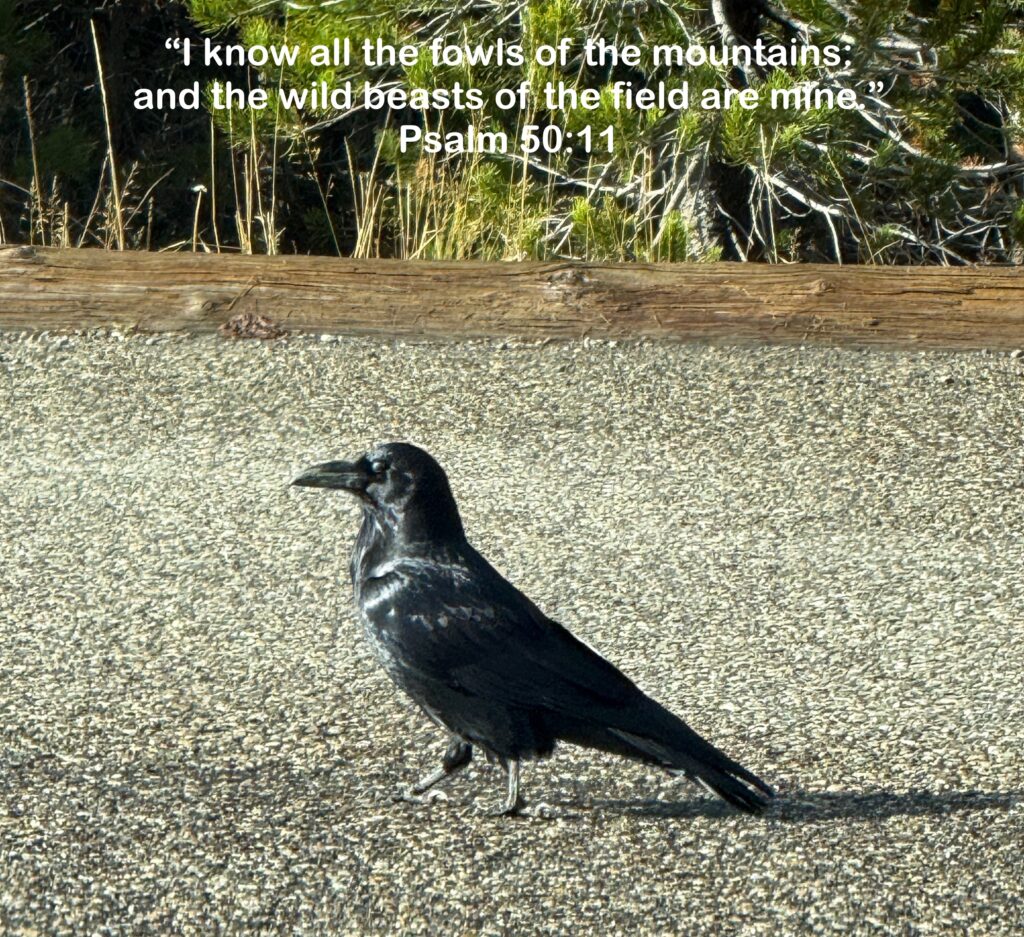
Two types of birds I saw that were very similar in appearance were the Brewer’s blackbird and the great-tailed grackle. I had to delve into my bird book to find the differences in order to correctly identify them. The differences were small, but once I knew what to look for, I could tell which bird was which. One other bird that seemed to be everywhere was the raven! These large ebony birds, that look like giant crows, were fearless and often approached people with a hilarious deep-throated sound. It was impossible for me to differentiate between each one as they seemed identical… solid black with no distinguishing features!! Scientists speculate that there are about 16 million of these huge black birds in the world! Imagine knowing each one of those ravens individually. Impossible for us, but God knows each one.
The Bible tells us in Luke 12:6 that God knows every sparrow. “Are not five sparrows sold for two farthings, and not one of them is forgotten before God?” Today, scientists say there are approximately 1.6 BILLION house sparrows in the world, and God knows EVERY ONE of them! Isn’t that just amazing? By the way, that number of sparrows doesn’t include other varieties of sparrows: chipping, song, etc.
But what is even more incredible is that the next verse, Luke 12:7, tells how much more special we are to God when Jesus says, “… ye are of more value than many sparrows.” Here’s what is really incredible. The latest census puts the population of the world at approximately 8.3 billion, and God knows each one of us individually. Jeremiah 1:5 affirms this, “Before I formed thee in the belly I knew thee; and before thou camest forth out of the womb I sanctified thee…”
Think about this. Scientists estimate there are approximately 85 BILLION birds on the earth. The Bible tells us that God takes care of all the birds… all 85 billion of them! The first part of Matthew 6:26 states, “Behold the fowls of the air: for they sow not, neither do they reap, nor gather into barns; yet your heavenly Father feedeth them…” But that verse goes on to ask the question, “…Are ye not much better than they?” Certainly, gives one pause, doesn’t it?
God did not send His Son to die for any animal. He sent Jesus to die for His last creation… man. God formed us with His hands and then breathed into us His breath to create us with a living soul in order to have a relationship with us! Then after humanity sinned, severing that relationship, God sent His Son, Jesus, to bear the punishment we deserved on a cross to provide a way for us to be reconciled to Himself. He became the Saviour of the world as the disciple wrote in 1 John 4:14, “And we have seen and do testify that the Father sent the Son to be the Saviour of the world.” We are indeed “much better” in God’s eyes than the birds or anything else He created.
All that the birds can do is sing to the Lord. While we can do much more, let us begin by doing as the birds do. Psalm 95:1-3, 6 exhorts us, “O come, let us sing unto the LORD: let us make a joyful noise to the rock of our salvation. Let us come before his presence with thanksgiving, and make a joyful noise unto him with psalms. For the LORD is a great God, and a great King above all gods…O come, let us worship and bow down: let us kneel before the LORD our maker.” It is the least we can do, but it is the very act of our humble worship and praise that pleases and glorifies God the most.
Meditation:
How does knowing the value of yourself in God’s eyes impact your relationship with Him?
How does your worship of the Lord bring Him glory?
Scripture: “Whither shall I go from thy spirit? or whither shall I flee from thy presence? If I ascend up into heaven, thou art there: if I make my bed in hell, behold, thou art there. If I take the wings of the morning, and dwell in the uttermost parts of the sea; Even there shall thy hand lead me, and thy right hand shall hold me.” – Psalm 139:7-10
Examination of Chapter: This psalm encapsulates three qualities of God: omnipotence, omniscience, and omnipresence. David acknowledges that God is with him, no matter where he may be (omnipresence), God knows everything he does or says (omniscience), and God is the Creator of all things and can destroy all his enemies (omnipotence). God is always watching over us, caring for us, and protecting us.
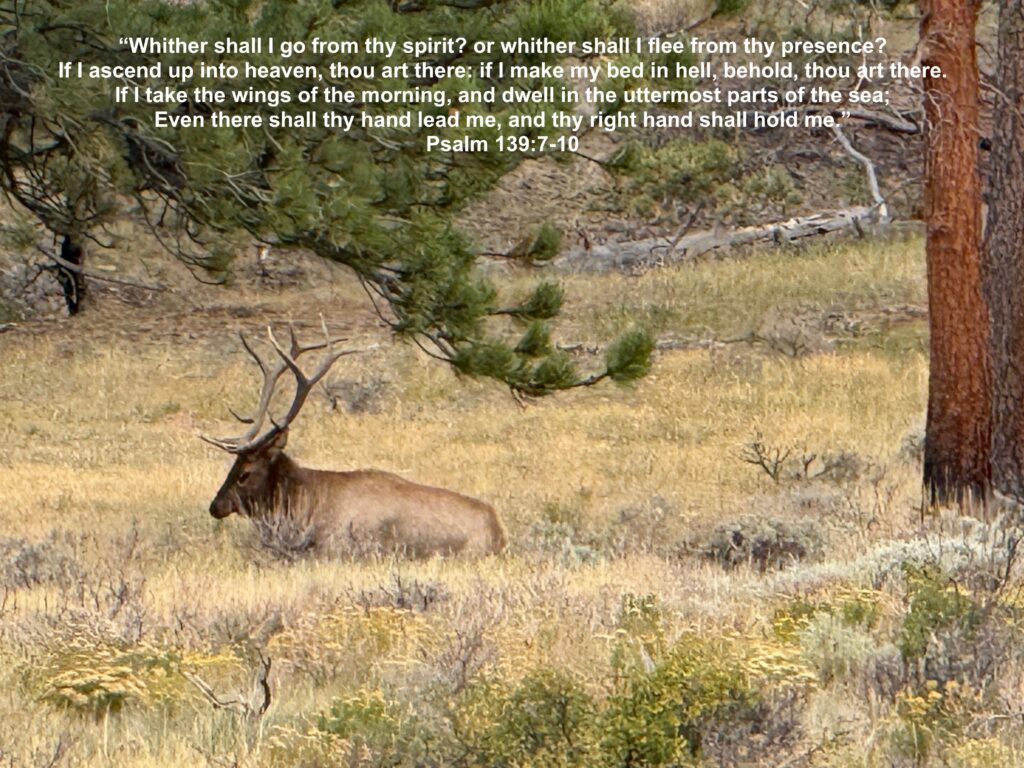
Application: During our recent road trip, we visited several national parks that abounded with a variety of amazing animals. We saw moose, deer, bear, eagles, and even a little pika! One of the most majestic animals we saw was the bull elk. This creature is very large in stature with huge antlers. On one occasion, I witnessed a bull elk standing in a clearing and seemingly staring into space. In reality, he was on the alert, constantly surveying the perimeter of his herd of cow elks as they grazed about 50 yards away. He stood looking for any sign of a predator or other approaching danger that would threaten his herd. On another occasion, in a small town, a small herd of cow elk stopped traffic as they calmly walked across the street to the left side. Across the road on the right, a bull elk moved behind a few more cow elk, waiting for them to cross before he followed the group. Both occasions painted a very vivid picture for me of how our heavenly Father watches over us.
Jesus tells us in John 10:29 that we are firmly held in the hand of God. “My Father, which gave them me, is greater than all; and no man is able to pluck them out of my Father’s hand.” God protects us, cares for us, and keeps us secure in Him. He is our “bull elk”. It doesn’t matter if I draw away from him, as pictured by the cow elk grazing a distance from the bull, or if I am close to him, represented by the bull elk who was prodding his cows in the direction they should go across the street, I am secure in my heavenly Father’s hand. I will never lose the salvation that Jesus provided for me through His death, burial, and resurrection. But like a cow elk, I can stray and get myself in a dangerous predicament!
If a cow elk wanders, she becomes vulnerable to predators. Likewise, when I wander away from the Lord (which I do on occasion), I am susceptible to attack from both worldly and spiritual forces. The cow elk can find her way back to the herd by using her sense of smell and hearing, but it could be a perilous journey. She may emit a “lost cow call”, hoping the bull will hear, find her, and bring her back to the herd. When I have strayed from God, I engage my “lost cow call”- my prayers! The Bible affirms that God will hear me and take action in Psalm 91:15, “He shall call upon me, and I will answer him: I will be with him in trouble; I will deliver him, and honour him.” God will then answer me through His Word and His Spirit, closing the gap between us, and safely bring me back to where I should be… near to His heart.
Regardless of the distance between the cows and the bull, that single bull elk steadfastly watches the herd, ready to spring into action at the moment danger is present. He can run at a speed of 40-45 mph to engage the predator. Similarly, regardless of the distance I put between me and the Lord, He is always aware of everything happening to me in my life. Like the cows protected by the bull regardless of the situation, I am protected by my Lord. No matter what I do, no matter what the world throws at me, no matter what Satan tries to do to me, the Bible promises me that I am protected always by the hand of God. Deuteronomy 31:6 states, “Be strong and of a good courage, fear not, nor be afraid of them: for the LORD thy God, he it is that doth go with thee; he will not fail thee, nor forsake thee.”
The last elk scenario I saw on this trip involved a huge bull elk laying down in the grass near some trees with his head up and his antlers high. A little bit farther in the area, maybe 20-25 yards away, rested a cow elk in the grass. She was watching all of us “looky-loos”, but showed no distress as she chewed her cud. The bull kept his eye on her, near enough to protect her should the need arise, but close enough that he didn’t have to stand at alert. He could easily rise up and defend her at a moment’s notice because the distance was not great. Like the cow elk, I need to be so close to the Lord that no enemy would dare approach. I must purposely stay near my Lord through prayer and Bible study. By keeping myself in close proximity to God, I am at peace knowing that my soul is safe, and He is ready, willing, and able to fight any spiritual enemy that comes near. Psalm 121:7-8 affirms this, “The LORD shall preserve thee from all evil: he shall preserve thy soul. The LORD shall preserve thy going out and thy coming in from this time forth, and even for evermore.”
Scripture: “I will greatly rejoice in the LORD, my soul shall be joyful in my God; for he hath clothed me with the garments of salvation, he hath covered me with the robe of righteousness, as a bridegroom decketh himself with ornaments, and as a bride adorneth herself with her jewels.” – Isaiah 61:10
Examination of Chapter: Isaiah begins by stating his qualifications to the people of Israel as anointed by God to preach to them. He writes about the joy that God’s chosen people will experience when He restores Israel to its land.
Application: One of my favorite places to pray is in my car. While that may seem odd to some, I find it a place where I can bear my soul, cry, laugh, plead without any interruptions. I play instrumental hymns on my radio, and then have a time chatting with my heavenly Father. BTW, I do not bow my head, nor do I close my eyes! It’s good to know that no matter where I am or what position I am in, God still hears my prayers!
It truly baffles my mind to think that the Creator of all things, the Almighty God, knows my name, and not only that, but when I pray, His ear is inclined toward ME! He listens as if I were the only one praying! To me, that is absolutely overwhelming! After all, in the overall scope of things, I am merely one out of billions of individuals who have ever lived, yet God knows me specifically! That is simply incomprehensible!
I know that Jesus died for me, and I know without a doubt that I will spend eternity with Him, but I have to admit that it still amazes me to know that even when God knew exactly who I would be, what I would do, how I would disappoint Him again and again… even after being saved… that He still chose to give me life and eventually become part of His glorious family!
As I ponder my own state of depravity, which I still have regardless of being saved, I am faced with the reality of the weakness of my faith and how easy it is for me to choose sin over righteousness. This is not an attribute of which I am proud. Instead, it grieves me greatly. I find myself begging for forgiveness, which God always gives. I don’t know why He loves me as much as He does, especially since I don’t have anything to offer Him that He can’t obtain on His own. It is then that the Holy Spirit whispers to my heart, “Jayne, you don’t have to understand that. Just believe and accept the truth of my Word.” What a treasure to know that there is nothing I can do to merit God’s love. He gives it to me full and overflowing and that is overwhelming.
Here is what I know from the Word of God.
I don’t know why I am so important to Him; I just know that I am.
“How precious also are thy thoughts unto me, O God! how great is the sum of them!” – Psalm 139:17
I don’t know why He has a specific plan for my life, but I know that He does.
“For I know the thoughts that I think toward you, saith the LORD, thoughts of peace, and not of evil, to give you an expected end.” – Jeremiah 29:11
I don’t know why He inclines His ear towards me when I pray, but I most certainly know that He does.
“I love the LORD, because he hath heard my voice and my supplications. Because he hath inclined his ear unto me, therefore will I call upon him as long as I live.” – Psalm 116:1-2
I don’t know why He continually works on me, but I know that He does.
“Being confident of this very thing, that he which hath begun a good work in you will perform it until the day of Jesus Christ:” – Philippians 1:6
Lastly, I don’t know why He loves me like He does, but I am certain He does.
“The LORD hath appeared of old unto me, saying, Yea, I have loved thee with an everlasting love: therefore with lovingkindness have I drawn thee.” – Jeremiah 31:3
Isaiah 64:6 speaks to the truth of our unworthiness, “But we are all as an unclean thing, and all our righteousnesses are as filthy rags; and we all do fade as a leaf; and our iniquities, like the wind, have taken us away.” But the wonderful truth of my relationship with God is that I don’t rejoice in who I am or what I’ve done for Him; I rejoice solely in Him! Habakkuk 3:18 states, “Yet I will rejoice in the LORD, I will joy in the God of my salvation.” I rejoice because God loves me and saved me from my sins! His joy became mine forever the moment I accepted Christ as my Saviour! No matter what happens in my life, no matter how I feel or don’t feel, the wonderful truth of God’s Word is found in my relationship with Jesus. 1 Peter 1:18 reinforces this, “Whom having not seen, ye love; in whom, though now ye see him not, yet believing, ye rejoice with joy unspeakable and full of glory:”
I love my prayer time in my car because every time the Lord and I share a drive, His Spirit speaks to my heart in the most remarkable ways, and for that, I rejoice! Philippians 4:4 instructs us to “Rejoice in the Lord alway: and again I say, Rejoice.” I can rejoice in the Lord always simply because I am a child of God! With Jesus as my Lord and Saviour and my eternal joy, I can truly “Rejoice evermore” as it tells me to do in 1 Thessalonians 5:16.
Memory verse: “But let the righteous be glad; let them rejoice before God: yea, let them exceedingly rejoice.” – Psalm 68:3
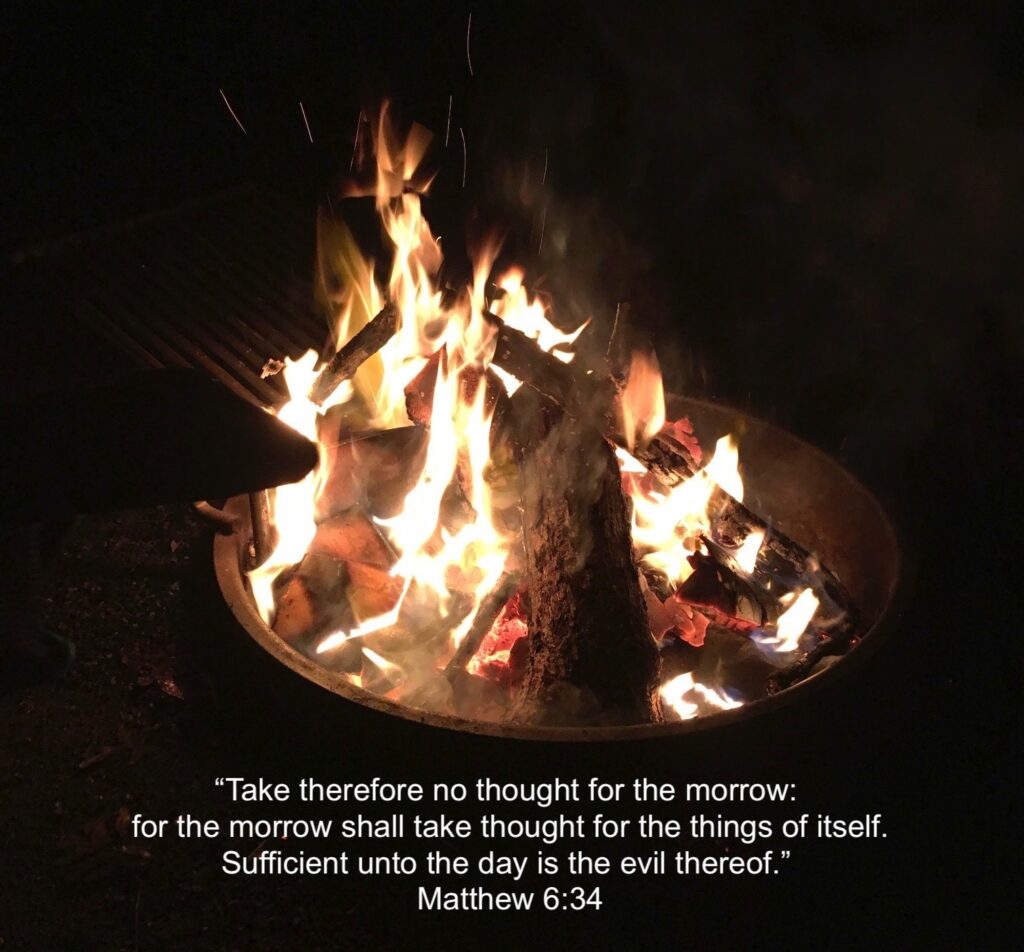
Scripture: “Take therefore no thought for the morrow: for the morrow shall take thought for the things of itself. Sufficient unto the day is the evil thereof.” – Matthew 6:34
Examination of Chapter: Matthew writes the words of Jesus as He continues His famous teaching known as the “sermon on the mount”. In the last section of this chapter, Jesus is cautioning against worry. He tells His followers that no amount of worry can influence the things of the world. God is in control of everything. In verse 34, Jesus states that each day has its own issues and to worry about what will be is futile. Pay attention to the events of the day, which are troublesome enough instead of worrying about what may be in the future.
Application: Worry is what we do when we don’t get the outcome that we desire. Constant worrying is not a healthy trait to possess; it is similar to a raging wildfire. It starts with a small flame and then quickly escalates to consume everything in its path, and it’s not easy to extinguish.Worry can be ignited by many different things. For example, when my husband had cardiac issues, I worried a lot in those hours I sat in the waiting room. Did I pray? Yes, I did, but honestly, I worried more than I prayed.
I forgot that I truly didn’t need to worry about the outcome of my husband’s surgery because the reality was, and is, that God had it covered. What I needed to remember was that my God is the same God as the God of Daniel, Elijah, Esther, Ruth, Peter, and every other believer in the Bible. That list is a powerful reminder of the faithfulness of God. Intellectually, I know that God will meet my needs because He said so in His Word, but sometimes my heart overrules my head. What I forget is that my heart is deceitful as it says in Jeremiah 17:9, “The heart is deceitful above all things, and desperately wicked: who can know it?”
As I pondered the bondage of worry, the proverbial light bulb went off in my head. By the way, this light bulb was turned on by the Holy Spirit as He spoke to my heart. It was as if He said, “Jayne, you don’t have to worry about this. I really have it covered. I love you. I’m going to take care of you in all things. I know when you pray to me that you want a specific thing, and sometimes I answer as you wish, but sometimes I don’t. I respond to your prayer in ways that are best for you and that are in alignment with my will, and I need you to trust me.”
Sometimes I simply forget how great and mighty our God is, and that the antidote to my worry is to trust Him. The Bible tells me to pray and cast my cares upon Jesus; it does not tell me to worry about what God’s going to do or how He’s going to do something to alleviate the situation. For example, when I pray to God about my huge medical bills, I don’t know if God will meet that financial need in a miraculous way or by showing me how to finance it. But I do know that my responsibility is to bring every single care to Him as it says in I Peter 5:7, “Casting all your care upon him; for he careth for you.”
Sometimes, even with this understanding, the flames of worry begin to grow. It’s easy for me to justify my worries. After all, I don’t want to deplete my savings. I don’t want this expense to be a financial hardship. Worry creeps in because I want an outcome that leaves my savings intact and doesn’t cause any monetary discomfort. I find that much of my worry hinges on two words: “I want…” See the problem? I want what I want, and worry comes because I’m not getting what I want. I struggle because I don’t like God’s timing; I don’t like God’s decisions; I don’t like God’s will… wait, what? Yes, worry is “I-centered”, not “God-centered’. If I truly want God’s will for my life, I need to gear up and fight the fires of an often out-of-control worry by taking God at His word and trusting Him to meet every need I have.
That is so freeing when I think about it! When I trust God at His Word, I realize that He has said He’ll take care of me and meet every single need in my life. I don’t have to be the one to make things happen. The responsibility isn’t on my shoulders; it’s on His. Philippians 4:19 states, “But my God shall supply all your need according to his riches in glory by Christ Jesus.” If He said it, He has to do it because the Bible also tells me that God does not lie. He keeps His promises. Numbers 23:19 affirms, this. “God is not a man, that he should lie; neither the son of man, that he should repent: hath he said, and shall he not do it? or hath he spoken, and shall he not make it good?”
The truth is worry is unnecessary because God does what is best for His children. I have to remember Isaiah 55:9, “For as the heavens are higher than the earth, so are my ways higher than your ways, and my thoughts than your thoughts.” Nowhere does the Bible tell me that I have to know why God is allowing certain things to come to pass or how it will all end, but it does tell me again and again to trust God. Proverbs 3:5 tells us, “Trust in the LORD with all thine heart; and lean not unto thine own understanding“, and Psalm 37:5 states, “Commit thy way unto the LORD; trust also in him; and he shall bring it to pass.”
However, in spite of all that head knowledge, worrying is not an easy thing to turn off. In my flesh, I will face many challenges that will ignite the embers of worry within me. I will stoke those flames by allowing my mind wander to the “what-ifs”, and before I realize it, the worry wildfire is burning out of control. So how do I douse the flames before they consume me? I go to God and ask Him for help. My flesh is quite strong, but it’s not stronger than God. So I seek Him, His guidance and wisdom, and then I wait on Him. Isaiah 40:31 states, “But they that wait upon the LORD shall renew their strength; they shall mount up with wings as eagles; they shall run, and not be weary; and they shall walk, and not faint.”
For whatever reason, God allows me to go through various challenges and struggles in life. Some I understand; others I do not. But what I do know is that I am not called to know every reason that God has for what happens in my life; I am called to trust Him. I don’t need to obsess about what may or may not be. I need to focus on today, and let God handle my tomorrows. The truth is that God has me firmly in His hand. The same God of Esther, Ruth, Rahab, and so many more in the Bible is the same God who shelters me in His arms. The way He cared for Noah, Daniel, Naomi, Paul, and others is the same way God cares for me today. I really don’t have to worry. I don’t have to see the light at the end of the tunnel because I know Who walks with me through each of those challenging tunnels. I will reach the destination that He has mapped out for me by simply holding on to His hand. God promises to lead me, and He will never fail me.
Each time I give my worries to Jesus, which I might add is an on-going struggle, I am released from the burdensome, oppressive imprisonment that comes with stress and anxiety. I am so grateful the Holy Spirit gently and humbly puts out the fires of worry by whispering to me that He’s got it all in His control! Is it easy to surrender my worries? Nope, not at all, but that’s why we have His Word. Verses in scripture remind me over and over and over about the mighty power of God and how He takes care of what belongs to Him. Matthew 6:26 states, “Behold the fowls of the air: for they sow not, neither do they reap, nor gather into barns; yet your heavenly Father feedeth them. Are ye not much better than they?” Jesus suffered and died on a rugged cross for me. I am so loved by Him, so valued by Him, so wanted by Him. Why would I doubt He would take care of me? How could I not trust Him to take care of me? And if Jesus is taking care of me, there really isn’t any plausible reason as to why I should worry. When the waters of God’s incredible love pour over me, the flames of worry die out, and I am at peace, trusting and resting in Him.
Memory verse: “Come unto me, all ye that labour and are heavy laden, and I will give you rest.” – Matthew 11:28
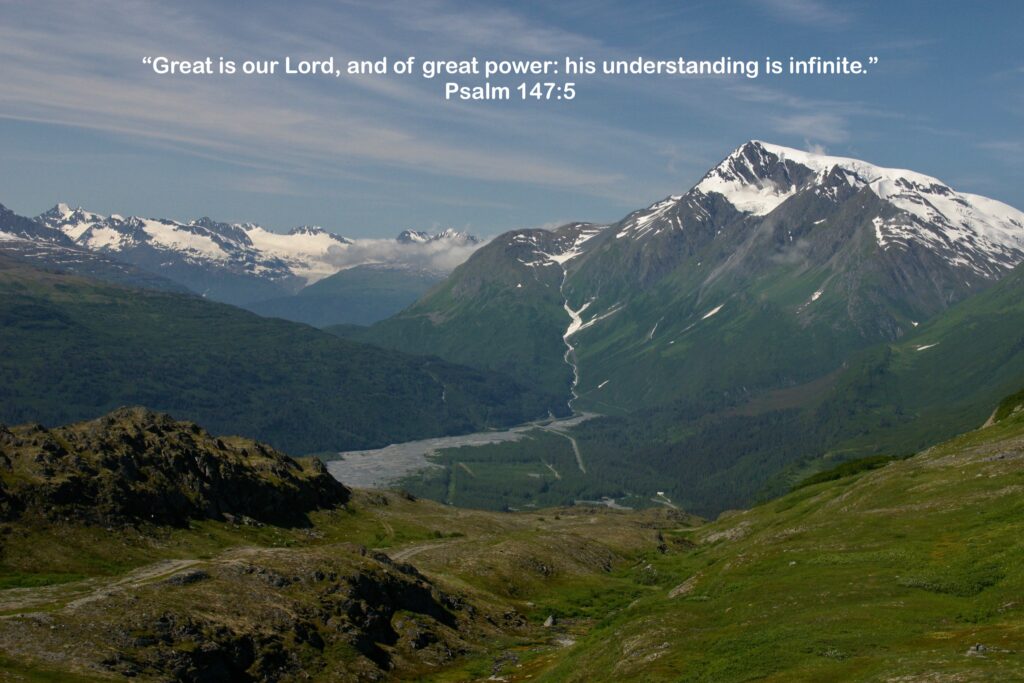
Scripture: “Great is our Lord, and of great power: his understanding is infinite.” – Psalm 147:5
Examination of Chapter: David begins this psalm by stating that he is in dire straits, but is awaiting the Lord to intervene. As he waits, he writes of how he has worked to do God’s will and share Him with others. David cries out that he needs God to act quickly, and he affirms that God will deliver those who belong to Him.
Application: Today as my husband and I arrived at a restaurant for a quick dinner before our church’s midweek services, we found that the power to all the stores in this particular area had quit. After discussing our alternatives, we decided to head to another place a bit down the road. Unfortunately, the traffic signal between where we were and where we were headed was out as well.
Since it was around 5pm, many businesses had finished for the day, and their employees were on this busy road heading home. Consequently, at the intersection with the non-functioning lights, cars were going through one at a time. It was a long wait, but finally, it was our turn. We zipped through and into nearby Dairy Queen that had its lights on! We made it back to church only about 20 minutes later than usual, still having plenty of time to set up for the evening programs.
Interestingly enough, my lesson for my Sparks group in AWANA was about the power of God. As I waited for my clubbers to arrive, I had time to reflect on the truth that the power of God never shuts off! The Bible tells us that God is omnipotent… all powerful. There is nothing in all of creation that is more powerful than the Lord and certainly no power source that is eternal except the Almighty God, Creator of all that exists. Revelation 19:6 proclaims, “And I heard as it were the voice of a great multitude, and as the voice of many waters, and as the voice of mighty thunderings, saying, Alleluia: for the Lord God omnipotent reigneth.”
I’ve heard the amazing stories where God’s power is demonstrated, but truthfully, the magnitude of what He really did is beyond me. Imagine stopping a storm simply by ordering the wind and waves to cease. Think about being so powerful that you could restore perfect sight to the blind or raise a dead person back to life!
That’s the power of our God!
What’s even more amazing is that His power is within each true believer. Ephesians 3:20 states, “Now unto him that is able to do exceeding abundantly above all that we ask or think, according to the power that worketh in us…” I am empowered by His Spirit that has lived within me ever since I accepted Jesus’ forgiveness and accepted Him as my Lord and Saviour, and I can do all things through Christ (Philippians 4:13).
One day, the manifestation of God’s power will no longer be an abstract concept to me. I will be in His presence, and all things will be revealed and understood clearly. Luke 8:17 states, “For nothing is secret, that shall not be made manifest; neither any thing hid, that shall not be known and come abroad.” Until that day, I will trust Him to keep me by His incredible power that never goes “on the blink”!
Memory verse: “Who are kept by the power of God through faith unto salvation ready to be revealed in the last time.” – 1 Peter 1:5
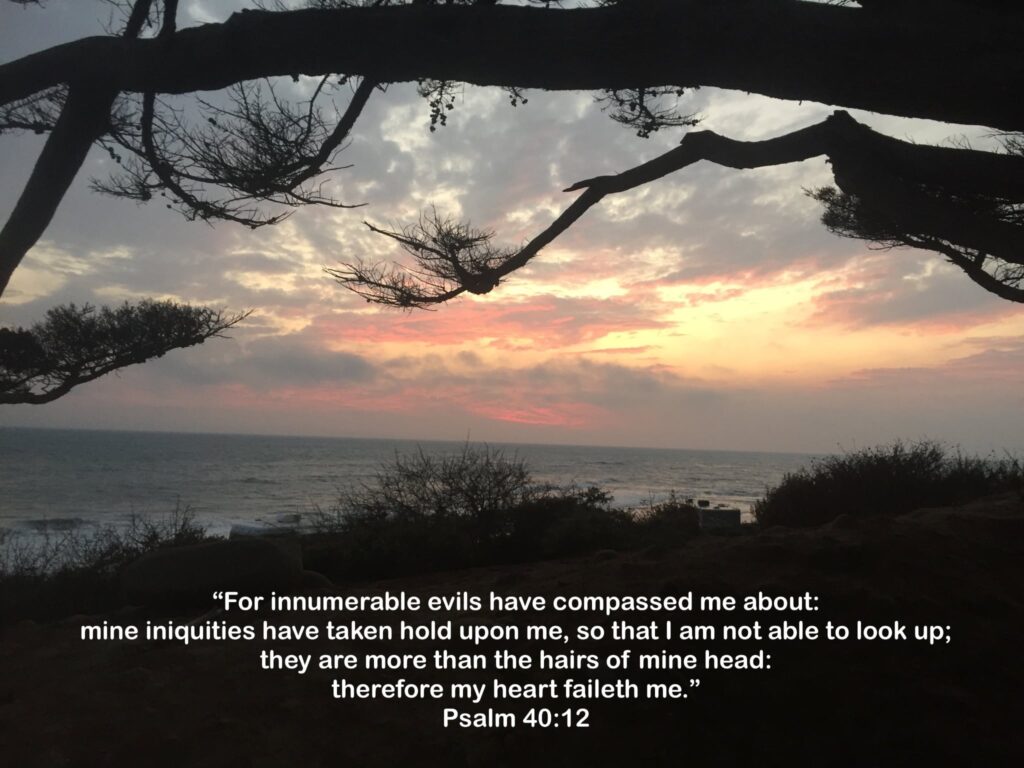
Scripture: “For innumerable evils have compassed me about: mine iniquities have taken hold upon me, so that I am not able to look up; they are more than the hairs of mine head: therefore my heart faileth me.” – Psalm 40:12
Examination of Chapter: David begins this psalm by stating that he is in dire straits, but is awaiting the Lord to intervene. As he waits, he writes of how he has worked to do God’s will and share Him with others. David cries out that he needs God to act quickly, and he affirms that God will deliver those who belong to Him.
Application: The other day I was working at my church with a friend. When we had finished, we hopped in our cars and prepared to head home. As I pulled out of my parking space, I noticed a hornet was in my car. I quickly stopped in the parking lot, jumped out, and opened the doors to allow the hornet an easy exit. It wasn’t interested in taking it. My friend, who was leaving also, noticed I had stopped in the middle of the parking lot and drove over next to me. I explained why I was standing outside of my car, and she proceeded to help me locate the hornet and shoo it out.
Within a minute or so, the hornet flew out, and I thought we were ready to leave until it flew over to her car for a moment, then quickly returned and entered my car AGAIN! With my friend’s assistance, it didn’t take long for us to manage to get that hornet to fly out once more. I quickly hopped in my car and rolled up all the windows. She did the same in her car, and finally, we were both on the road heading to our destinations without the fear of a vicious sting!
As I drove, I reflected on this situation, and it struck me that this was exactly how sin can be in our lives. We can be going along fine and then all of a sudden, sin appears and threatens to endanger our relationship with Jesus!
When the hornet was a danger to me, I was desperate for a way to escape its threat! I threw open the car door in my escalating fear and practically fell out of the car in my haste to get away from the hornet! I couldn’t get out of my car fast enough! 1 Corinthians 10:13 tells me that, like my car door, God always provides a way to flee the temptations of sin in my life. “There hath no temptation taken you but such as is common to man: but God is faithful, who will not suffer you to be tempted above that ye are able; but will with the temptation also make a way to escape, that ye may be able to bear it.” In order for me to escape the hornet, I had to employ the opening my car door provided. It is the same for sin. If I don’t avail myself of the escape route God provides, I will get stung!
Another way the hornet reminded me of sin was that it kept flying back to my car. Like that treacherous insect, sin is relentless. I once heard this statement, “Opportunity knocks once, but temptation leans on the doorbell”! How true! When sin rears its ugly head, that’s when the prayers and counsel of others is critical in helping us fight against its temptation. When my friend hopped out of her car and helped me chase the hornet away, she was interceding on my behalf! I was so terrified of that hornet, that I just stood away from my car hoping it would go away, but my friend when into action. Her selfless efforts resulted in the hornet finally flying away. Likewise, reaching out to others and asking for prayer or godly advice helps protect us from being “stung” by sin! 1 Timothy 2:1 instructs us to intercede for one another. “I exhort therefore, that, first of all, supplications, prayers, intercessions, and giving of thanks, be made for all men.” My friend’s intervention facilitated my safety from the threat of multiple stings!
God instructs the prayer warriors in our lives to intercede for us in times of need. Ephesians 6:18 states, “Praying always with all prayer and supplication in the Spirit, and watching thereunto with all perseverance and supplication for all saints;” Intercessory prayer is an important part of a Christian’s life, and we must remember that God calls each of us to be prayer warriors for one another. James 5:16 explains why, “The effectual fervent prayer of a righteous man availeth much.” Those prayers help fortify us against the temptations of sin that surround us daily.
Sin will always be a part of our lives until Jesus comes again, but no matter the magnitude of the temptation, we have the means to fight back and escape the entrapment of sin, and we don’t have to do that alone.
Lastly, 1 Corinthians 15:57 states, “But thanks be to God, which giveth us the victory through our Lord Jesus Christ.” We are promised victory over sin when we avail ourselves of all that Jesus has promised in His Word, for as 1 John 4:4 reminds us, “Ye are of God, little children, and have overcome them: because greater is he that is in you, than he that is in the world.”
Memory verse: “Submit yourselves therefore to God. Resist the devil, and he will flee from you.” – James 4:7