“He hath shewed thee, O man, what is good; and what doth the LORD require of thee, but to do justly, and to love mercy, and to walk humbly with thy God?” Micah 6:8
Do you ever ask yourself, “What should I do?” I do, but most of the time, I already know the answer to that question. Often, it’s just that I don’t want to do it. Choosing to do right “goes against my grain.” My sin nature wants its own way, but that way is a path that leads to destruction (Proverbs 14:12).
All through the Bible, God makes very clear what I should do, and the prophet Micah reminds me what God has already shown me throughout His Word. Verse 8 of Micah 6 is a reminder that I should be doing what is good in the sight of the Lord. Deuteronomy 12:28 states, “Observe and hear all these words which I command thee, that it may go well with thee, and with thy children after thee for ever, when thou doest that which is good and right in the sight of the LORD thy God.” Micah reiterates what it is that is good. I should be just, love being merciful to others, and walk humbly with God. Sounds easy, but for me, it’s not.
According to the KJV Dictionary, being “just” means being “influenced by a regard to the laws of God, or living in exact conformity to the divine will.” I must act according to what God deems as righteous and true, and to know what that is, I must go to the Bible. It is there that God reveals His perspective on truth and righteousness, which is vastly different from that of the world. It is His truth and righteousness that I must incorporate into my life.
The KJV Dictionary defines “mercy” as “That benevolence, mildness or tenderness of heart which disposes a person to overlook injuries, or to treat an offender better than he deserves; the disposition that tempers justice, and induces an injured person to forgive trespasses and injuries.” This is a characteristic that I should love, which I do, especially when someone is merciful to me. Of course, when it is in regards to me showing mercy to others, it is not always as easy. Why? Because I have a sin nature that is contrary to mercy. Sometimes I want to dispense judgment instead of mercy, but that is not God’s way. Jesus told us in Luke 6:36, “Be ye therefore merciful, as your Father also is merciful.” It is only through the work of God’s Holy Spirit in my life that I am able to be merciful to others. 2 Samuel 22:26 states, “With the merciful thou wilt shew thyself merciful, and with the upright man thou wilt shew thyself upright.” If I desire God’s mercy upon me, I must demonstrate mercy to others. I need not only to be merciful, but I need to love being merciful as well.
The last part of Micah 6:8 refers to walking with God. For me, this started with my salvation in 1968. Once I accepted Jesus as my Saviour, I begin to cultivate my new relationship with Him through personal prayer and the reading of His Word. I wanted to know Him better, so I took steps to achieve do so. I can remember when I first met Him. It was new and exciting, but as the years passed, my relationship with Him became deeper and more meaningful as I spent more time with Him. That’s the same as when we make new friends. They don’t start out being close. It takes time and effort to develop deep and trusting relationships. That’s exactly how it is with God.
My walk with God takes work because He wants me to walk humbly with Him. Humility is an understanding of who I am compared to who He is. Simply put, there is no comparison! God is completely worthy of all praise, honor, and glory, and I am not. Romans 12:3 states, “For I say, through the grace given unto me, to every man that is among you, not to think of himself more highly than he ought to think; but to think soberly, according as God hath dealt to every man the measure of faith.” I am a prideful person in my flesh, but the Holy Spirit keeps me mindful that pride is a sin, and that I must “Humble yourselves in the sight of the Lord, and he shall lift you up”(James 4:10). To say I am unworthy is a huge understatement, but… (and I thank God for the “but” in this sentence) despite my unworthiness, He loves me with an everlasting love (Jeremiah 31:3) and desires to have a personal relationship with me! Knowing this compels me to walk more humbly with God.
Finally, I realize that obedience is not always easy, but it is best for me to obey God. Why? Because He will never lead me astray. As I focus my gaze upon Jesus, I see how He is my example to fulfilling those things that the Lord requires of me.
- Jesus is just – “Tell ye, and bring them near; yea, let them take counsel together: who hath declared this from ancient time? Who hath told it from that time? have not I the LORD? and there is no God else beside me; a just God and a Saviour; there is none beside me.” Isaiah 45:32
- Jesus is merciful – “Keep yourselves in the love of God, looking for the mercy of our Lord Jesus Christ unto eternal life.” Jude 1:21
- Jesus is humble – “And being found in fashion as a man, he humbled himself, and became obedient unto death, even the death of the cross.” Philippians 2:8
- Jesus walks with God – “I and my Father are one.” John 10:30
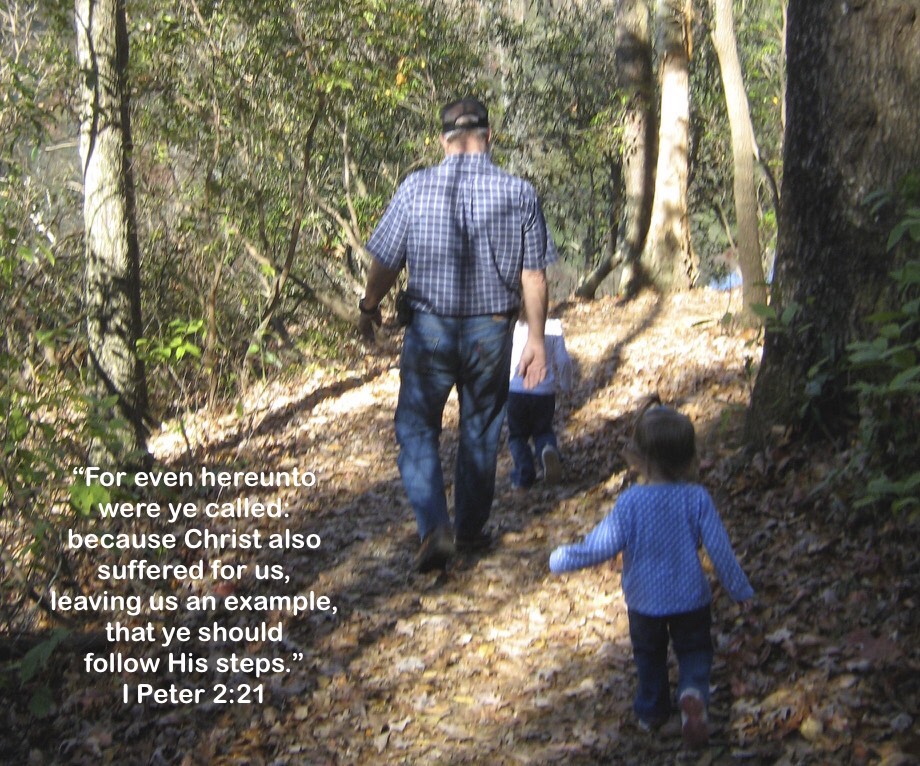
Following in the footsteps of Jesus is often difficult for me. I tend to stray onto my own path, but through God’s Word, His Holy Spirit always illuminates the right way for me to go and draws me back to where I should be. As I strive to follow Christ, I must always be “Looking unto Jesus the author and finisher of our faith; who for the joy that was set before Him endured the cross, despising the shame, and is set down at the right hand of the throne of God” (Hebrews 12:2).
If I want to do that which is “good in the sight of the Lord,” I know exactly who to follow!
Sweetly, Lord, have we heard Thee calling,
Come, follow Me!
And we see where Thy footprints falling
Lead us to Thee.
Footprints of Jesus,
That make the pathway glow;
We will follow the steps of Jesus
Where’er they go.
(from “Footprints Jesus” by Mary Slade)
**********
Take time to deepen your relationship with God. Read the Bible; say a prayer. It will change your life for the good!